Does Making Money Make Someone a Less Ethical Dog Breeder?
By Husky Jim
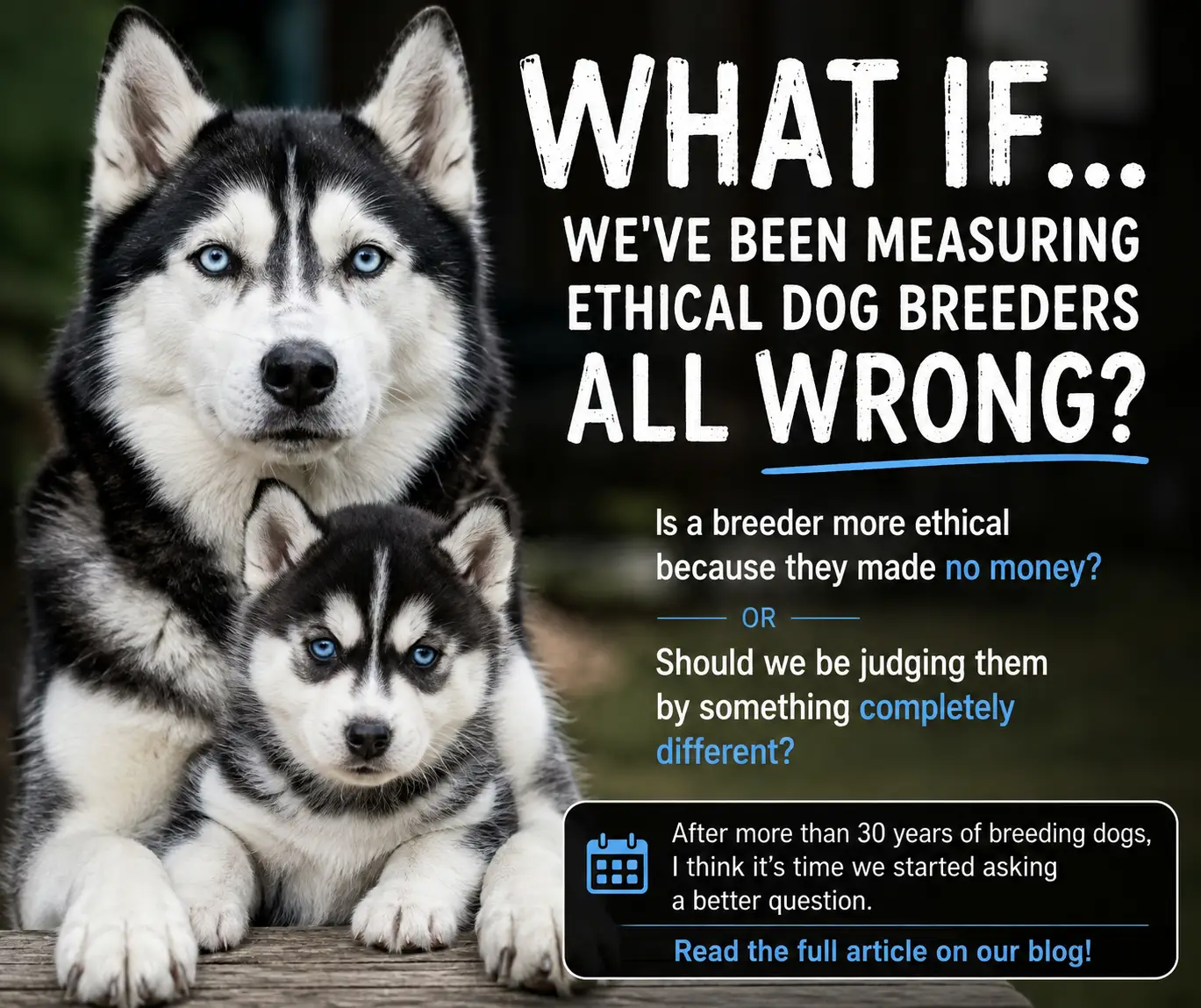
One of the strangest beliefs I see today is the idea that if a breeder makes any money from a litter, they must somehow be less ethical.
I’ve never understood that.
Some people seem to believe the best breeders are the ones who barely break even
or better yet, lose money. As though financial struggle is somehow proof of compassion.
I don’t believe that’s true.
I believe an ethical breeder should first be judged by the things that actually matter.
Are the breeding dogs healthy?
Are they well cared for?
Do they live in a safe, clean environment?
Do they receive excellent nutrition, veterinary care, appropriate health testing, enrichment, and daily attention?
Are the puppies healthy, stable, and given the very best start in life?
Are families thoughtfully matched with the right puppy?
Does the breeder continue supporting those families long after the puppy goes home?
Those are the questions that matter.
Not whether there happened to be money left after the bills were paid.
What Responsible Breeding Really Costs
People often think breeding dogs is mostly about financial expense.
And yes, there are plenty of expenses.
Quality nutrition.
Veterinary care.
Health testing.
Vaccinations.
Deworming.
Supplies.
Facilities.
Cleaning.
Enrichment.
Emergency medical care.
Record keeping.
Transportation.
Insurance.
The list goes on and on.
But after more than thirty years of breeding dogs, I’ve learned that money is only part of the cost.
The biggest investment isn’t dollars.
It’s your life.
Raising a litter costs time.
It costs energy.
It costs sleep.
It costs focus.
It costs availability.
When you have puppies, they don’t simply fit into an empty corner of your schedule.
They become part of your schedule.
Sometimes that means getting up in the middle of the night while everyone else is asleep.
Sometimes it means changing your plans because a puppy needs attention.
Sometimes it means postponing projects, putting hobbies on hold, or giving up a peaceful evening because your dogs need you more.
The people who have never raised a litter just see the puppy.
They rarely see everything that happened before that puppy ever met its family.
They don’t see the years spent learning.
They don’t see the anxious nights during whelping.
They don’t see the constant cleaning.
The weighing.
The record keeping.
The early socialization.
The developmental monitoring.
The countless conversations with families.
The emotional weight that comes with accepting responsibility for every life you bring into the world.
Those sacrifices aren’t something breeders should expect applause for.
They’re simply part of accepting the responsibility.
Sustainability Isn’t the Enemy of Ethics
Here’s the question I always come back to.
If all of those responsibilities are handled well…
If the breeding dogs receive exceptional care…
If the puppies are healthy and well-socialized…
If families are carefully selected…
If support continues long after the puppy goes home…
And after all of that, there’s still money left over…
Does that somehow make someone a worse breeder?
I don’t think it does.
I don’t think a breeder is more ethical because they’re broke after every litter.
I don’t think they’re more compassionate because every dollar disappeared.
And I certainly don’t think they’re more responsible because one unexpected emergency could put them out of business.
A financially sustainable breeding program isn’t something to apologize for.
It’s what allows responsible breeders to continue improving.
Better facilities.
Better nutrition.
Better veterinary care.
Better equipment.
Emergency preparedness.
Continuing education.
Better breeding decisions.
Long-term support for puppy families.
Every one of those things benefits the dogs.
Responsible breeding and financial sustainability are not opposites.
When done ethically, they make each other possible.
A Better Way to Judge a Breeder
One thing I’ve noticed over the years has always made me curious.
I can’t tell you how many conversations I’ve had with families who previously bought a puppy from another breeder.
Years later, when they’re ready to add another dog to their family, they’ll often tell me the same thing:
“We wanted another puppy from the breeder we bought from before… but they don’t breed anymore.”
I’ve heard that story over and over again.
I don’t know exactly how many breeders are still active five years after they begin.
Or ten years.
I haven’t found anyone who keeps those statistics.
But based on the conversations I’ve had over more than three decades, it has left me with the impression that responsible dog breeding is often a much shorter journey than many people expect.
There are certainly breeders who dedicate decades of their lives to it, and I have great respect for those who do.
But I also believe many people discover that breeding responsibly requires far more time, emotional energy, financial commitment, and personal sacrifice than they ever imagined.
Many people can raise a litter.
Far fewer can build a breeding program that continues serving dogs and families year after year.
That’s why I think longevity deserves more attention.
Not because years alone make someone a great breeder.
But because maintaining a responsible breeding program over many years requires consistency, continual learning, adaptability, and an ongoing commitment to doing what’s best for the dogs.
When I meet a breeder who has cared for dogs responsibly for ten, twenty, or thirty years, I don’t assume they’re perfect.
But I do recognize the dedication it takes to keep showing up for the dogs, year after year.
The Standard That Matters
The measure of a breeder has never been whether they made a profit.
The measure is whether they did right by the dogs.
Did they provide exceptional care?
Did they make thoughtful breeding decisions?
Did they raise confident, healthy puppies?
Did they place those puppies with families prepared to give them wonderful lives?
Did they stand behind those puppies long after they left home?
That’s the standard I believe we should judge breeders by.
Not whether there was anything left over after the bills were paid.
Because at the end of the day, ethical breeding isn’t measured by someone’s bank account.
It’s measured by the lives they improve.
The dogs they protect.
The trust they earn.
The responsibility they demonstrate every single day.
And perhaps, just as importantly, whether they’ve built a program that can keep doing those things for years to come.
Because good breeding isn’t about one successful litter.
It’s about building something that serves dogs and families with the same care, integrity, and commitment year after year.
That’s the legacy worth building.
My Philosophy
Every breeder has their own philosophy.
This one is mine.
I’m not asking anyone to judge my breeding program by clever marketing, beautiful puppy pictures, or promises.
I’m asking to be judged by the things that truly matter.
Look at the condition of my dogs.
Look at the health and temperament of the puppies we’ve raised over the years.
Look at the families we’ve had the privilege of serving.
Look at the support we continue to provide long after our puppies leave our home.
Look at the consistency of a program we’ve spent decades building, learning from, and continually improving.
Every responsible breeder will have their own approach, and I respect that.
But I believe every breeding program should be evaluated by its outcomes, its responsibility, and its commitment to the dogs not by assumptions about whether the breeder personally benefited from a litter.
If you’re considering a Bama Huskies puppy, I encourage you to hold us to those standards.
Ask questions.
Learn about our dogs.
Learn about our philosophy.
Take the time to understand how we raise our puppies and why we make the decisions we do.
Then decide for yourself whether we’ve earned your trust.
Because in the end, that’s all any responsible breeder can ask.
Not to be judged by opinions.
But to be judged by the lives of the dogs we’ve raised.
The families we’ve served.
The trust we’ve earned.
And the reputation we’ve built over time.
That’s the standard I believe in.
And that’s the legacy I hope Bama Huskies continues to leave for many years to come.